
KEYNOTE 180
Teach · Lead · Learn · Grow — with AI EdTech
AI EdTech Weekly Brief
Issue No. 8 · October 19, 2026 — prepared by Keynote 180 for educators & education leaders.
Recap: Last week’s top story here was Frederick County, Maryland’s school board voting 6-1 to ban AI for every grade, pre-K through 12, just weeks after piloting Google’s Gemini. This week the same fault line widened statewide: the Baltimore Sun reports that despite a Maryland law requiring every district to adopt a formal AI-use policy by this fall, four districts are now on track to miss that deadline. One county banned the technology outright; others still can’t produce the paperwork to govern it at all.
This Week’s Trending Tool: AI for All: Essentials for Educators — the federal AI-literacy course Canada’s Minister of Artificial Intelligence and Digital Innovation, Evan Solomon, unveiled with the Alberta Machine Intelligence Institute (Amii), is this week’s most contested EdTech rollout. The Canadian Teachers’ Federation says the course pushes adoption ahead of safety and efficacy evidence, pointing to a British Columbia survey in which more than 80% of teachers worried about students growing dependent on AI. Its backers frame it as foundational AI literacy for every classroom; its critics say the sequencing is the problem — train first, prove it works later.
Top Use Cases
District Administrators
Maryland’s AI-policy deadline comes due — and four districts are missing it 🚩
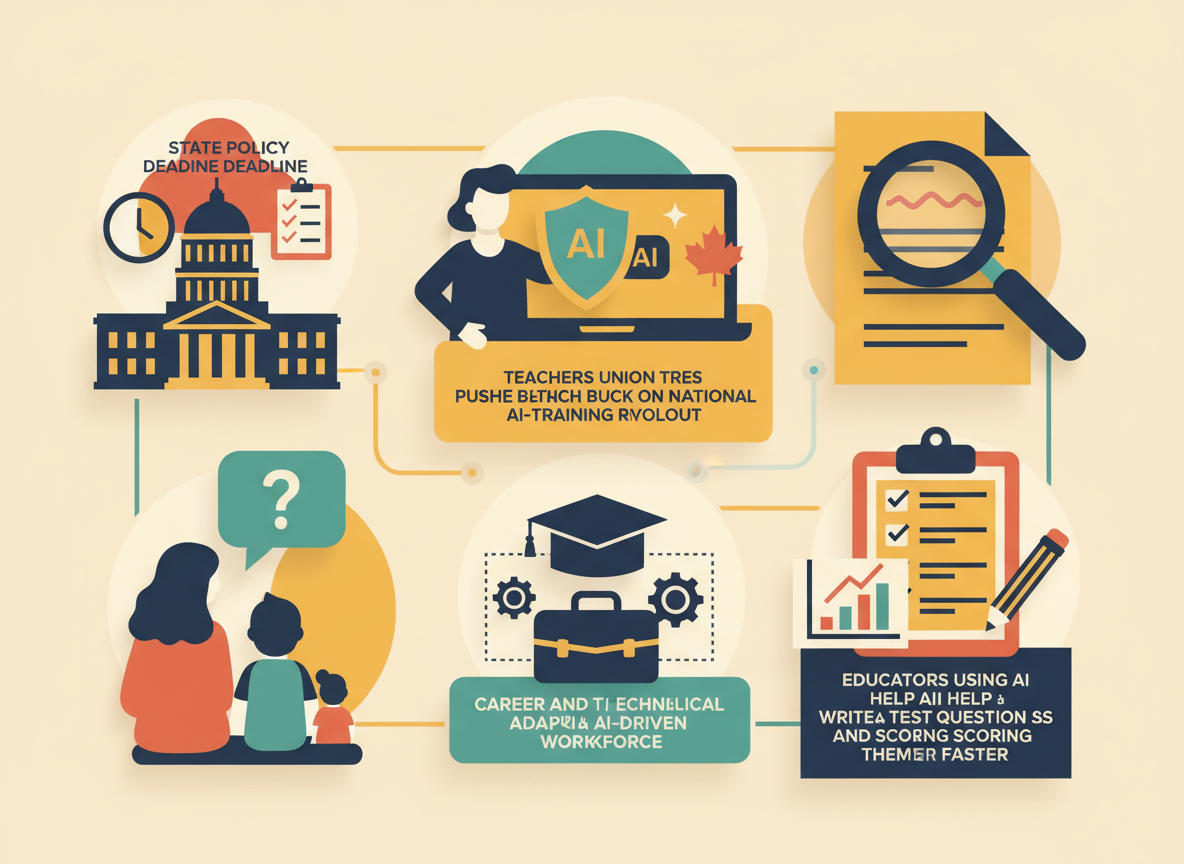
Maryland’s law required every public school district to adopt a formal AI-use policy by this fall, but the Baltimore Sun reports four districts won’t make the deadline, leaving them without any governance framework just as neighboring Frederick County swings to an outright ban. For administrators elsewhere, it’s a reminder that “policy” and “pilot” are now running on two different clocks, and a missed deadline carries its own reputational risk even without a single incident attached to it.
Educational Leaders & Principals
AI quietly creeps into test-question writing and scoring
In K-12 Dive’s October 12 week-in-review, Temple Lovelace of the Assessment for Good program described educators increasingly turning to AI to help draft test questions and speed up scoring — a quieter, administrative use case next to this month’s headline bans and pilots. For building leaders setting next semester’s professional-development priorities, assessment workflow may be where AI enters a school’s daily routine long before any formal classroom policy catches up to it.
Teachers
Canada’s national AI-literacy course for teachers draws union pushback 🚩
The Canadian Teachers’ Federation says Ottawa’s new “AI for All: Essentials for Educators” course, developed with Amii, asks teachers to adopt AI tools before anyone has shown the approach is safe or effective, citing a British Columbia survey in which most teachers worried about student dependence on the technology.
A Philadelphia teacher checks Google Docs edit histories to catch AI-written work
Grid Magazine’s October 16 reporting profiles Bodine High School teacher Kate Reber, who reviews students’ document revision histories rather than relying on AI-detection software to judge whether work is genuinely theirs — a low-tech workaround for a problem most commercial detectors still handle unreliably.
Students
Philadelphia students say AI use is already showing up in classmates’ grades
Central High School junior Michelin Delgado told Grid Magazine that AI’s fingerprints are visible in how unevenly her classmates are graded, in a district where families say the rules are unclear even as New York City and the Los Angeles Unified School District have already imposed one-year moratoriums on some student AI use.
Parents
Philadelphia parents say the district hasn’t explained its AI rules 🚩
Parents Edwin Mayorga (Palumbo High School) and Keren Sofer (Science Leadership Academy Middle School) told Grid Magazine that the School District of Philadelphia has never clearly communicated what AI use is and isn’t allowed, echoing Brookings Institution fellow Rebecca Winthrop’s broader warning against giving students unrestricted chatbot access without a plan. The frustration voiced in Philadelphia will sound familiar to any parent whose own district hasn’t explained its policy either.
Employability & Career Readiness
Is Perkins V ready for an AI-driven workforce? 🚩
Writing in THE Journal on October 12, Thamir Aljobori argues that the federal Perkins V career-and-technical-education law, last updated in 2018, hasn’t kept pace with AI, and calls for a faster CTE response in fields like cybersecurity and robotics, portable stackable credentials, and tighter employer-college partnerships — warning that rural, low-income, and multilingual students risk falling further behind without them.
1 Emerging Trend to Watch This Week — From adoption to accountability. Across this week’s stories, enthusiasm isn’t driving the conversation anymore — governance is. Maryland districts are missing policy deadlines. Canada’s teachers’ union wants proof before rollout. Philadelphia parents want a straight answer on what’s allowed. The AI-in-schools story is no longer “will we adopt it.” It’s “can anyone show their work.”
Sources
- Baltimore Sun — To AI or Not: 4 Maryland School Districts to Miss State Policy Deadline
- GlobeNewswire — Canadian Teachers’ Federation Concerned National AI Literacy Initiative Puts Adoption Before Safety
- Grid Magazine — AI Tools Are Already in Philly Classrooms. Are They Hurting Student Learning?
- K-12 Dive — Week in Review: October 9, 2026
- THE Journal — Perkins V Isn’t Preparing Students for an AI-Driven Workforce
Edited by Dr. H. M. Saleem, — Founder, Keynote 180
Discover more from Keynote 180
Subscribe to get the latest posts sent to your email.

