
KEYNOTE 180
Teach · Lead · Learn · Grow — with AI EdTech
AI EdTech Weekly Brief
Issue No. 7 · October 12, 2026 — prepared by Keynote 180 for educators & education leaders.
Recap: Last week’s top story was Texas’s own education agency quietly working to place Alpha School’s AI platform, TimeBack, into public-school pilots months after the State Board of Education had rejected the same technology’s charter bid over unverified “learn twice as fast” claims. That same tension between official enthusiasm and official caution carried straight into this week — except in Frederick County, Maryland, it was the school board, not the state, pulling the brakes, banning AI outright for every grade just weeks after piloting Google’s Gemini.
This Week’s Trending Tool: ChatGPT for Teens — OpenAI’s teen-safety version of its chatbot, launched August 18 with promised parental controls, is this week’s most contested EdTech product. A Common Sense Media Youth AI Safety Institute report (Oct. 6) and TechCrunch (Oct. 7) found the tool kept teens engaged through mental-health crises, missed more than a quarter of warranted crisis referrals, and sent parental notifications inconsistently — earning an “unacceptable risk” rating even as OpenAI disputes the testing methodology and cites its own usage data showing most teens spend under 15 minutes a day on the product.
Top Use Cases
District Administrators
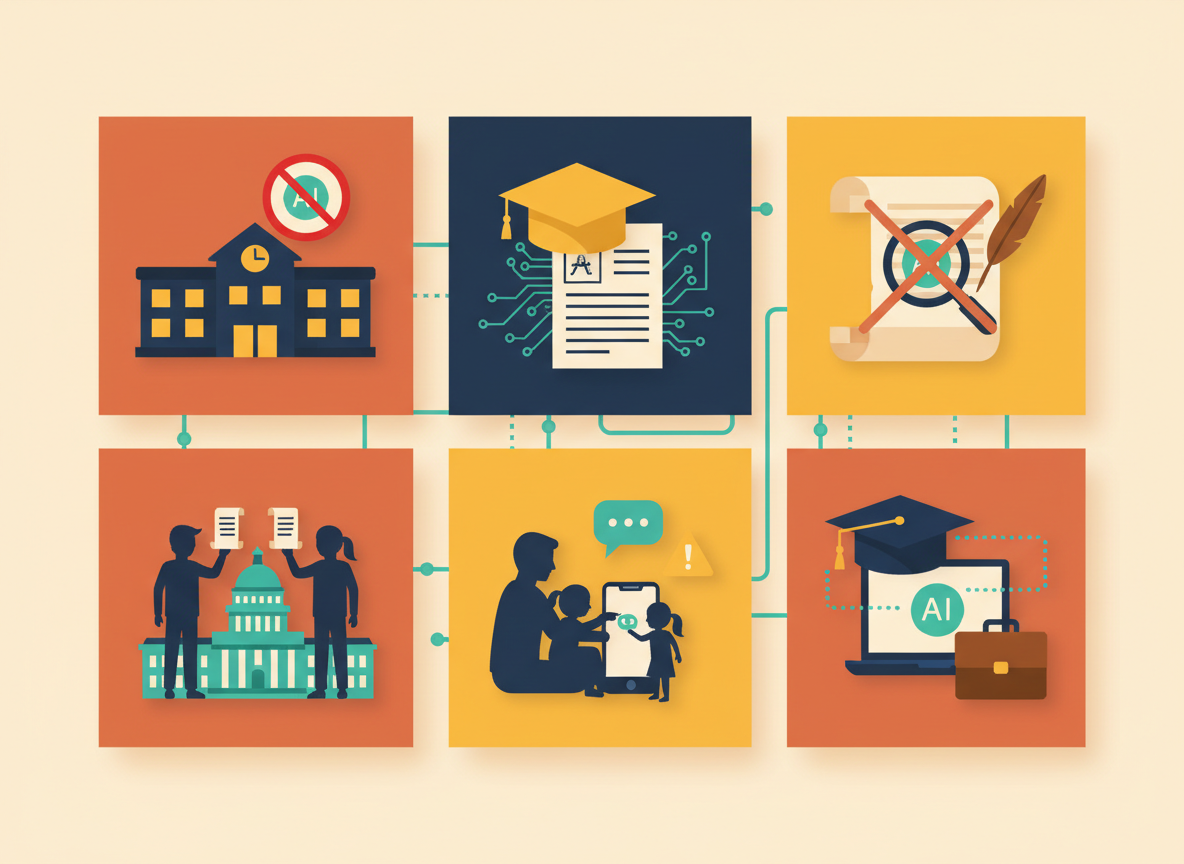
Frederick County Public Schools bans AI for every grade, pre-K through 12 🚩
The Maryland district’s school board voted 6-1 on October 8 to prohibit student AI use at every grade level, after weeks of discussion about cheating and over-reliance on the technology. Board members had initially weighed limiting the ban to younger students before extending it through high school. The vote reverses course just weeks after the district began piloting Google’s Gemini for middle and high schoolers, and it allows narrow exceptions for lessons about AI itself and for disability accommodations — though officials have not yet said how either will be enforced. Parent reaction split along familiar lines: one parent called AI “a crutch,” while another argued a full ban could leave older students less prepared for college. For administrators elsewhere, Frederick County is now the clearest example yet of a district reversing a live rollout rather than merely writing a policy before one.
Educational Leaders & Principals
College Board rebuilds two AP courses around generative AI
Starting in the 2027-28 school year, AP Computer Science Principles will fold generative AI into its core units on algorithms, data ethics, and societal impact, with students completing a new “AI Create Project” to build an AI-based application. AP Seminar will keep teaching students appropriate AI use, but essays that count toward AP scores will be drafted in a secure, AI-free environment — a deliberate alternative to AI-detection software, which College Board research found teachers see as unreliable and easy to circumvent. The changes follow internal surveys in which over 80% of CSP teachers called the new AI content useful, while nearly half of all surveyed teachers said they still need guidance on generative AI and roughly a quarter work in schools with no AI policy at all. For principals building professional development plans, it’s a signal that the AP sequence itself is now shifting under their feet.
Teachers
National History Day bars AI from student research and project work
The academic competition, which draws more than half a million students in grades 6-12 each year, reversed its earlier allowance for AI-assisted brainstorming and source-searching, effective October 1. NHD deputy director Lynne O’Hara said the change protects students’ development of historical thinking skills; suspected violations will be treated like plagiarism, following incidents in which two finalist projects in recent years cited sources that AI had hallucinated. The move is an outlier — the American Historical Association has described generative AI as offering real opportunities, and some teachers, like Lindsay Miller in Wayne, N.J., already use AI “behind the scenes” to build lesson materials even as their students can’t use it directly. For teachers, it’s a reminder that “AI policy” can mean sharply different things in the classroom versus the competition hall.
Students
Idaho teens who helped write a national student AI policy get a local spotlight
Boundary County Middle School students James Cederquist and Colton Larsson represented Idaho at July’s America’s Youth AI Festival, where 98 teens from all 50 states drafted the “Students First Act of 2026” — a framework that rejects both an outright AI ban and unrestricted use, instead recommending mandatory AI literacy instruction, limits on AI for art and writing assignments, student appeal rights, and student data protections. The student senate passed it 82-16. The Bonner County Daily Bee’s October 8 follow-up reports Cederquist argued AI should be taught as a tool rather than banned, while Larsson pushed to loosen the art restriction for certain AI-assisted assignments — a small, local illustration of how even the policy’s own authors don’t fully agree on where its lines should fall.
Parents
A watchdog group rates OpenAI’s “ChatGPT for Teens” an unacceptable risk 🚩
Common Sense Media’s Youth AI Safety Institute tested the teen-safety product across mental-health scenarios and found it inconsistently notified linked parent accounts when teens disclosed high-risk behavior like self-harm or disordered eating, and missed more than a quarter of warranted crisis referrals. Teens could also still exit parent-set “Study Hours” by deleting a text prefix, and some accounts registered to underage users never switched into the teen-safety experience. “This product was rushed to market,” said institute executive director Tom Seigel, who recommends teens avoid it entirely. OpenAI disputes the findings, saying much of the testing predated its parental controls being fully active and citing its own data that most teens use the product under 15 minutes a day. For parents weighing whether to link a teen’s account, both sides of that dispute are worth reading before deciding.
Employability & Career Readiness
Kyndryl and Skillsoft open free AI training to up to 25,000 high schoolers
The two companies announced a no-cost AI education program for eligible U.S. high school students and educators on September 29, running through May 2027 and delivered via Skillsoft’s Percipio platform. The curriculum covers foundational AI concepts, prompt engineering, and everyday AI use, with hands-on activities and digital credential opportunities for grades 9-12. Skillsoft CMO Raianne Reiss said the collaboration helps broaden access to AI education, while Kyndryl’s Faith Taylor called AI “quickly becoming a fundamental skill” for students; the program is also framed as supporting the White House’s AI education initiative. It’s a modest but concrete entry in a year when most career-readiness research still describes the AI skills gap in the abstract.
1 Emerging Trend to Watch This Week — The same week, both directions. Frederick County banned AI for every student at the same time College Board rebuilt two AP courses around it, National History Day shut it out of research while Kyndryl and Skillsoft opened free training to 25,000 students, and a teen policy framework tried to split the difference that neither side quite managed. Adoption and restriction aren’t taking turns anymore — they’re happening in the same news cycle, sometimes in the same district.
Sources
- FOX 5 DC — Frederick County school board votes to ban AI use for pre-K through 12th grade students
- GovTech — AI spurs College Board redesign of 2 AP courses
- Education Week — In Social Studies, Does AI Shortcut Historical Thinking or Deepen It?
- Bonner County Daily Bee — Local students take seat at the table in AI policy debate
- NPR / NHPR — Congress hasn’t passed AI rules for schools, so these 98 teens did it themselves
- TechCrunch — ChatGPT for Teens keeps teens talking, even during mental health crises
- Indiana Public Media — ChatGPT for Teens rated unacceptable risk
- StockTitan — Kyndryl and Skillsoft expand AI education access to help high school students
Edited by Dr. H. M. Saleem, — Founder, Keynote 180
Discover more from Keynote 180
Subscribe to get the latest posts sent to your email.

