Teacher Tech.

AI EdTech Daily Brief โ€” Issue No. 2

KEYNOTE 180

Teach ยท Lead ยท Learn ยท Grow โ€” with AI EdTech


AI EdTech Daily Brief

Issue No. 2 ยท September 16, 2026 โ€” prepared by Keynote 180 for educators & education leaders.

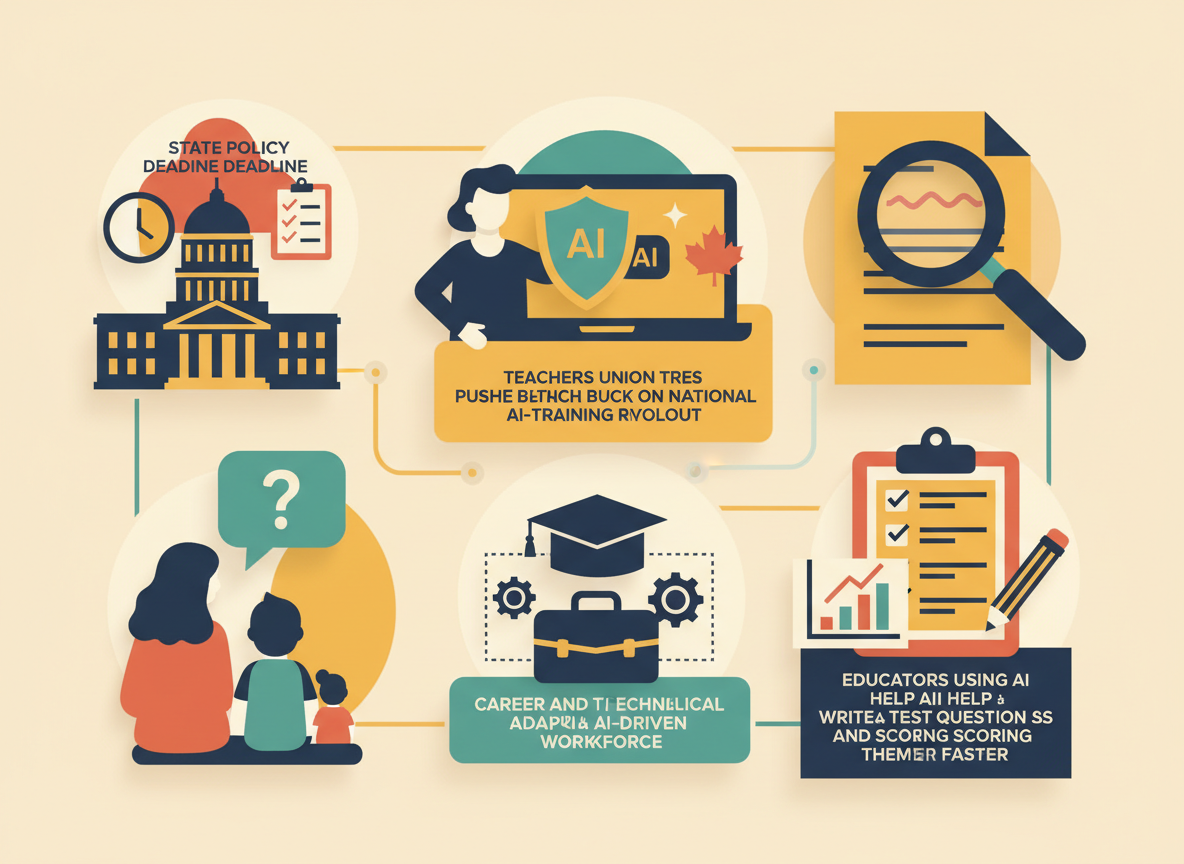
Recap: Yesterday’s issue tracked AI mental-health triage crossing from pilot to infrastructure after Kiwi’s high-profile save at Corsicana High School (Sept. 10) โ€” with D.C.’s new “stoplight” policy already flagging student-safety AI decisions as “yellow, caution required.” Today the story is scale: the nation’s two largest districts, New York City and Los Angeles, have both restricted generative AI on school devices for the new year, together affecting nearly 1 million students.

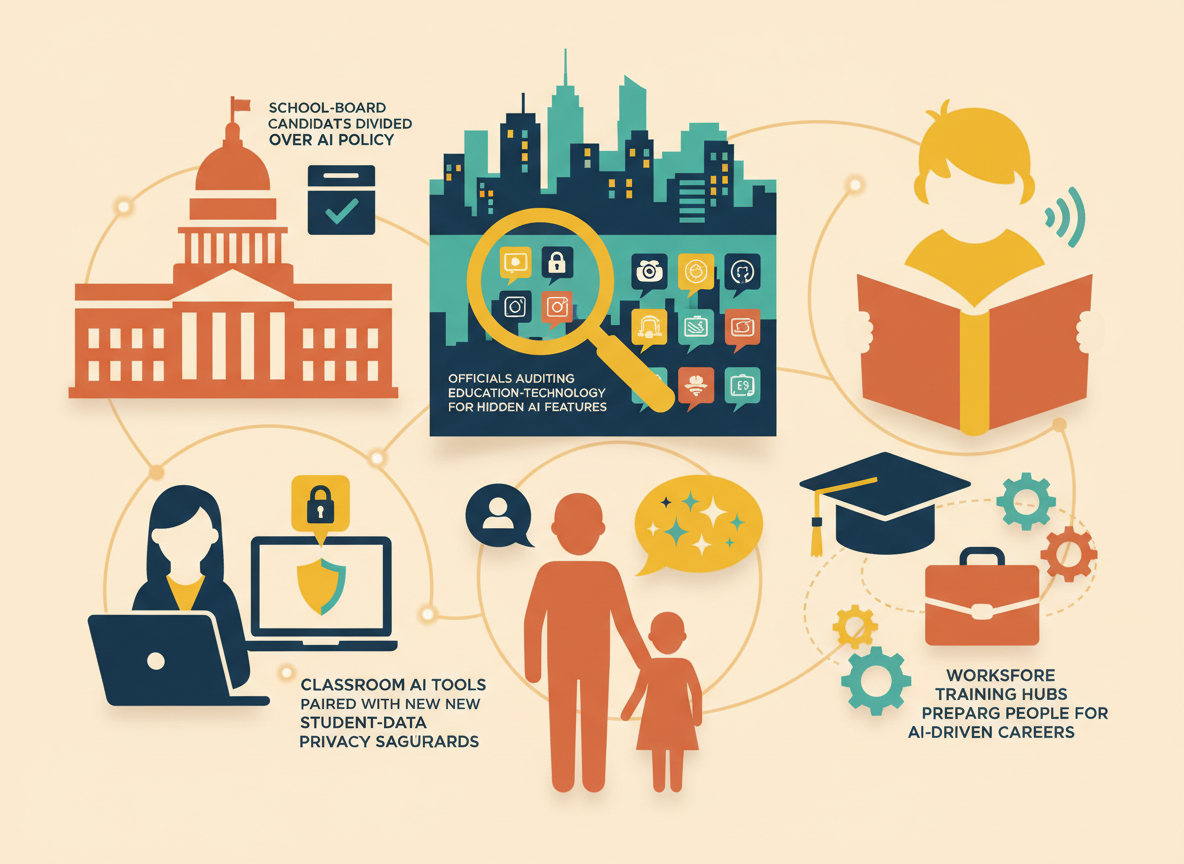
Today’s Trending Tool: SchoolAI, in Weber School District, Utah โ€” after a 65-teacher pilot proved out, the “walled-garden” AI platform for lesson planning, translation, and tutoring support scaled districtwide to 1,347 active users, roughly 87% of staff, backed by a signed data-processing agreement and mandatory bias/PII training. “It is saving our teachers tons of time,” staffer Monica Widdison said โ€” a rare AI rollout story where the privacy guardrails got built before the scale-up, not after.

Top Use Cases

District Administrators

NYC’s Nation-Leading AI Moratorium ๐Ÿšฉ

On September 2, Mayor Zohran Mamdani and Schools Chancellor Kamar Samuels announced a one-year ban on student-facing generative AI for New York City’s roughly 600,000 pre-Kโ€“8 students โ€” two-thirds of the system’s enrollment โ€” plus new screen-time caps (30 minutes daily for grades 3-5, 45 for grades 6-8) and a companion-chatbot ban for all ages. High schoolers get a narrower path: five vetted pilots and twice-yearly AI-literacy modules for up to 50,000 students. “We do not see” AI as inevitable, Mamdani said; Samuels framed it as protecting “the human connection, curiosity and creativity” school communities depend on. It’s the most sweeping restriction any major U.S. district has issued to date, and it lands as the model other superintendents will be measured against this fall.

LAUSD Follows With Its Own Device-Level Freeze

Six days later, the nation’s second-largest district confirmed a parallel move: Los Angeles Unified suspended generative AI on all district-owned devices for its roughly 378,000 K-12 students starting this school year, citing a June screen-time policy vote as its authority. Personal devices are untouched, and teachers keep their own AI access โ€” the freeze targets student use on school equipment only. Not everyone on the board signed off quietly: member Nick Melvoin noted the measure “didn’t really come from the board,” a reminder that even inside restriction-friendly districts, how a policy gets made is becoming its own story.

Educational Leaders & Principals

The Evidence Gap Behind Nine-Figure AI Bets ๐Ÿšฉ

Universities and districts are spending big โ€” OpenAI alone has sold at least 700,000 licenses to higher-ed institutions, and Cal State signed a $17 million contract in 2025 โ€” while, as Inside Higher Ed reported September 14, independent research on whether any of it improves learning barely exists. “The evidence base is almost nonexistent,” MIT’s Justin Reich said; Stanford’s Carly Robinson added that AI used “without intentional design or guardrails probably reduces learning through cognitive offloading.” For principals and superintendents fielding vendor pitches this budget season, it’s a blunt reminder to ask for outcomes data before signatures โ€” because right now, almost nobody has it to give.

An Equity Warning on the NYC Ban

Not every leader is cheering New York’s moratorium. Digital Promise CEO Jean-Claude Brizard warned it risks widening the gap it’s meant to close: affluent families will simply buy AI access their kids can’t get in school, while lower-income students go without either way. It’s the tension every restriction-minded administrator now has to hold at once โ€” protecting kids from unproven tools without quietly handing an advantage to families who can pay around the ban.

Teachers

RAND: Homework AI Use Jumps to 62% โ€” and So Does the Worry ๐Ÿšฉ

A RAND Corporation survey of 1,214 youth, released in March and widely re-cited this month, found student AI use for homework climbed from 48% in May 2025 to 62% by December โ€” driven mostly by middle and high schoolers. Even more striking: 67% of students now agree AI use is harming critical thinking, up more than 10 points in months. RAND’s recommendation for teachers isn’t a ban โ€” it’s clearer, consistent guidance that distinguishes cognitive offloading (AI doing the thinking) from augmentation (AI supporting it). That distinction, not a blanket rule, is what’s missing in most classrooms right now.

A Free, Grade-by-Grade AI Curriculum Lands

Day of AI, the MIT RAISE-born nonprofit, launched what it calls the nation’s first free PreK-12 AI literacy curriculum on August 19, with separate tracks for early elementary, upper elementary/middle, and high school. “A first grader shouldn’t learn about AI the same way a tenth grader does,” curriculum lead Valerie Brock said. MIT Media Lab’s Cynthia Breazeal put the goal plainly: not to make kids dependent on AI, but to “give them the knowledge and critical-thinking skills” to use it well. The nonprofit says it’s already reached 4 million students, with 93% of surveyed educators rating the materials “Good” or “Excellent” โ€” a ready-made answer for any teacher asking where to start.

Students

“The End of Homework?” โ€” 84% of High Schoolers Are Already Using AI ๐Ÿšฉ

The74’s deep dive into classroom cheating lands on an uncomfortable number: 84% of high schoolers reported using AI tools for schoolwork as of last year, and word-problem completion times dropped 31% post-ChatGPT โ€” with 25% fewer correct answers on AI-susceptible problems. Stanford’s Denise Pope put her finger on what’s actually being lost: “Students are not having the productive struggle needed to learn.” Fullerton teacher Al Rabanera’s response captures where most classrooms have landed: “I’m not going to pretend like you aren’t [using AI].” The debate has moved past whether students are using it โ€” it’s now about what gets lost when they do.

High Schoolers Get Mandatory AI-Literacy Training Under NYC’s New Rules

Buried inside New York City’s restriction is a requirement cutting the other way: the roughly 50,000 high schoolers in its five approved AI pilots must complete twice-yearly AI-literacy modules. Chancellor Samuels called it preparing “older students carefully and deliberately for a world where AI is already a part of their daily life” โ€” a reminder that even the country’s strictest AI policy isn’t trying to keep students ignorant of the technology, just sequencing when and how they meet it.

Parents

Parents Are Paying for AI Help Even When They Doubt It Works ๐Ÿšฉ

A study of roughly 2,000 parents across the U.S., Canada, and UK, reported September 9, found something close to a “tech arms race”: when parents perceived AI use among their teen’s peers rising from 20% to 80%, their own willingness to pay for premium AI tools jumped more than 60%, adding about $11 in average spending. Nearly 1 in 5 cited fear of their kid falling behind as the reason โ€” even though support for school AI bans actually rose, from 44% to 57%, once parents learned more about the potential harm to learning. University of Chicago economist Leonardo Bursztyn’s read: it’s peer-pressure economics, not conviction, driving the spending.

Employability & Career Readiness

Employers Are Already Raising the Bar for AI Skills ๐Ÿšฉ

ZipRecruiter’s 2026 AI Employer Report found 74% of employers now view AI skills as a strong advantage or a strict requirement, and 38% have already shifted basic data-processing tasks from entry-level workers to AI itself โ€” while 31% have quietly raised experience requirements for first jobs. “AI is changing the way employers plan for their workforce,” ZipRecruiter economist Nicole Bachaud said; “employers want higher-skilled, higher-producing candidates.” For career-readiness programs, the message is blunt: the entry-level rung on the ladder is getting higher, not disappearing.

A Framework for CTE: “Reshape,” Not “Replace”

A new white paper on career and technical education, co-authored by Dr. Cameron Sublett, argues the useful question for CTE programs isn’t “which jobs will AI eliminate” but “how will AI reshape the work inside them.” Its “Applied Co-Intelligence” model asks programs to braid AI mastery, occupation-specific technical skill, and transferable skills like communication and judgment into one track โ€” echoing MIT economist David Autor’s research showing AI reshapes task combinations far more often than it deletes whole jobs outright.

1 Emerging Trend to Watch This Week โ€” From Pilots to Policy Brakes. New York City and Los Angeles, the nation’s two largest school districts, have now both restricted generative AI on student devices for the new school year โ€” nearly 1 million students combined. It’s happening at the exact moment Inside Higher Ed reports the independent research base on whether AI actually helps learning is “almost nonexistent.” Expect more districts to follow the brakes before the evidence catches up, even as tools like SchoolAI and Day of AI’s new curriculum show there’s still real appetite for AI adoption when the guardrails come first.

Sources


Edited by Dr. Hafiz M. Saleem, Ed.D. โ€” Founder, Keynote 180

Standard
Teacher Tech.

AI EdTech Daily Brief โ€” Issue No. 1

KEYNOTE 180

Teach ยท Lead ยท Learn ยท Grow โ€” with AI EdTech


AI EdTech Daily Brief

Issue No. 1 ยท September 15, 2026 โ€” prepared by Keynote 180 for educators & education leaders.

Recap: This is your first daily brief โ€” no recap available yet. Starting tomorrow, this space will track yesterday’s top story and flag any follow-up developments.

Today’s Trending Tool: Kiwi (by Alongside) โ€” a viral Sept. 10 story about a Texas high school intercepting a self-harm disclosure through this AI companion is turning mental-health chatbots from “experimental” to “essential infrastructure” in short-staffed counseling offices overnight.

Top 10 Use Cases โ€” Last 60 Days

District Administrators

D.C.’s AI “Stoplight” Policy ๐Ÿšฉ

When D.C.’s Office of the State Superintendent of Education found only 45% of districts had a staff AI policy โ€” and just 34% had one for students, despite 70% of teens already using AI for homework โ€” it skipped the 40-page manual and built a stoplight instead. The model policy released September 2 sorts AI use into green (drafting lesson plans, analyzing attendance data, composing parent messages), yellow (AI-assisted grading โ€” human sign-off required), and red (IEP decisions, discipline, teacher evaluations, anything touching student safety). It’s the plain-language guardrail administrators everywhere have been asking for, and policy architect Antoinette Mitchell’s framing โ€” grading should rest on a teacher’s judgment, not an algorithm’s output โ€” is a soundbite built for a leadership retreat.

Google Gemini, district-wide rollout

Dilworth-Glyndon-Felton Schools in Minnesota rolled out Google Gemini district-wide for the first day of school (Gemini stays off-limits for grades K-4; ChatGPT is blocked entirely through 8th grade), betting that a sanctioned tool beats pretending AI isn’t already in every backpack. The catch: families said the district hadn’t explained what this would actually look like in a fourth-grade classroom, and parent Nathan Axvig’s worry โ€” that AI shortcuts could erode time on foundational skills โ€” spread fast in the week after the August 19 rollout. It’s a live lesson in what happens when the tooling decision outruns the communication plan.

Educational Leaders & Principals

Microsoft Copilot + AI Fellows Program

Osceola County Schools in Florida didn’t hand principals a tool and hope for the best โ€” it built an 18-week AI Fellows Program, putting roughly 30 instructional and operational staff through hands-on work with Microsoft Copilot before any of them are asked to set policy for anyone else. Fellows present their findings directly to district leadership this fall, turning frontline experimentation into the evidence base for how the district scales AI next. Teacher-fellow Kim Castro-Stevens summed up the urgency well: “If we’re not staying ahead of it… we’re going to get left behind.” Grow your own AI-literate leaders before you mandate anything โ€” a model worth putting in front of any principal cohort.

Teachers

AI as classroom “thought partner” ๐Ÿšฉ

Jordan School District in West Jordan, Utah has run an AI tool as a classroom “thought partner” for two years, and just published the receipts: analysis of nearly 14,000 student-AI conversations across 82 teachers shows a 28% jump in critical-thinking skills and more than double the higher-level reasoning students showed before. The boundary that makes it work โ€” AI never grades the work or replaces the teacher, it only pushes students to defend their thinking โ€” is exactly the line districts elsewhere are still arguing about. Administrator Jared Covili’s framing is a whole keynote in one sentence: “The most revolutionary part is how much it helped them to show students what they knew.”

Agentic AI, teacher-built simulations

At Peninsula School District in Washington, a chemistry teacher used agentic AI to build interactive cell-membrane simulations, and the district’s new aeronautical academy used the same approach to build flight simulations for its CTE students โ€” no vendor contract required. CIO Kris Hagel’s point is the real story for teachers everywhere: agentic tools “can run on a schedule, they can do proactive work,” meaning teachers increasingly prototype their own instructional software instead of waiting on whatever platform got purchased last budget cycle. The district backed the shift with real investment โ€” about $4.5 million in devices โ€” but the payoff is teachers building exactly the tool a lesson needs, the day they need it.

Students

Kiwi (Alongside) mental-health companion ๐Ÿšฉ

Corsicana High School in Texas has three behavioral counselors for 1,800 students โ€” the kind of ratio that turns a 24/7 AI companion from novelty into necessity. When a student disclosed a detailed plan to self-harm to the school’s AI chatbot, Kiwi (built by Seattle-based Alongside, now live in 200+ schools across 19 states), the system flagged it instantly and counselors intervened before the student left campus that Friday. Principal Aaron Tidwell’s verdict โ€” “We actually saved a kid” โ€” went national on September 10 and reframed the debate from “should schools do this” to “how fast can under-resourced schools scale it.” With CDC data showing 40% of high schoolers report persistent sadness, this is as high-stakes as EdTech use cases get.

AI tutoring at national scale (Grok) ๐Ÿšฉ

El Salvador just handed the AI-in-education debate a startling data point: after a year-plus rollout pairing teacher coaching with AI tutors (built on xAI’s Grok) across 171 pilot schools, 1,198 tested students posted PISA-comparable reading, math, and science scores matching Germany and Sweden’s 2022 results โ€” a leap from a country that scored far below OECD averages that same year. The program has already scaled past 1,000 schools and is targeting every public school nationwide within roughly 18 months โ€” national scale, not a boutique pilot. Whatever your questions about the political framing behind it, the raw before/after numbers are the kind of proof point that quiets a skeptical room faster than any vendor deck.

Parents

General AI chatbots at IEP meetings

Parents are increasingly walking into IEP meetings having already run the draft through ChatGPT or Gemini to decode the jargon, check proposed goals against state guidelines, and draft their own questions โ€” turning an intimidating acronym-fest into something they can engage with as equal partners. The flip side, flagged by curriculum specialists in a September 11 EdSurge piece, is real: AI-drafted parent input can sprawl to 20-30 pages, contains errors because “AI is not an IEP expert,” and risks putting sensitive medical and legal details into tools with unclear data handling. The fix educators are converging on isn’t banning it โ€” it’s transparency, because as one special-education administrator put it, most educators can already tell when something was AI-written anyway.

Employability & Career Readiness

InternSync โ€” AI-matched internships ๐Ÿšฉ

Roughly 59% of young people never land an internship, and the biggest reason isn’t skill โ€” it’s not having a professional network to open the door. InternSync, a swipe-based platform that launched August 18, strips out that advantage by giving any high schooler a standardized profile employers can compare like-for-like, aggregating 8,000+ internships, research slots, and competitions that used to be scattered across a hundred different sites. Founder Shourya Kancharla’s line cuts right to the equity issue districts care about: “Opportunities should not depend on the depth of a student’s contact list.” A clean, concrete example of an AI-era platform leveling a field that’s been tilted toward well-connected families for decades.

“AI for the Workplace” micro-credential

SunEd High in Broward County, Florida started with a single-classroom pilot of the “AI for the Workplace” micro-credential and, on the strength of a 94% pass rate, scaled it to 400-700 students across three campuses this school year โ€” one of the cleanest examples yet of an AI-literacy credential moving from experiment to default curriculum. The stakes are real: employers report a 70-75% preference for candidates who can demonstrate AI proficiency over those who can’t. Student Zuatneymy C.’s take is the plainest employability pitch you’ll hear: “Every job that uses technology will use AI in the future.”

1 Emerging Trend to Watch This Week โ€” AI mental-health triage is moving from pilot to infrastructure. Kiwi’s viral save at Corsicana High, and the fact it’s already running in 200+ schools across 19 states, shows these tools crossing from “nice to have” to “the thing standing between a struggling student and a missed warning sign” โ€” especially as counselor ratios like Corsicana’s (1,800 students, 3 counselors) become the norm, not the exception. Worth tracking closely: D.C.’s new stoplight policy already flags AI-assisted student-safety decisions as “yellow โ€” caution required,” so the governance conversation is about to catch up fast to what’s already deployed in neighboring districts.

Sources


Edited by Dr. Hafiz M. Saleem, Ed.D. โ€” Founder, Keynote 180

Standard
District Admins, School Admins, School Counselors

AI Tools are here to address chronic student absenteeism

A student starts missing Mondays. Then Tuesdays. His grades slip quietly. No one notices โ€” until it’s too late.

*AI-powered Early Warning Dashboards are changing that story.*

Districts across the U.S. are now tracking attendance trends, grade trajectories, and engagement signals in real time โ€” flagging at-risk students weeks before crisis hits.

Not reactive. Proactive.

The shift: from “we found out after the fact” to “we acted before the slide.”
Counselors reach the right students sooner. Dropout rates fall. Resources go exactly where they’re needed most.

Data without compassion is just numbers. Data with compassion? That’s a student’s future saved.

Text/What’sApp: +1-973-531-7323 or email: dr.saleem@keynote180.com [www.keynote180.com] for an in-school/in-district training for your administrators on how to use these widely available attendance AI tools.

#AIinEducation#EdTech#K12#StudentSuccess#FutureofLearning

Standard
Language Arts Teachers, Math Teachers, School Admins, Science Teachers, Teacher Tech.

The Sunday Night Lie | Less Planning Nightmare

Every teacher knows the ritual.

Sunday. 9 p.m. The week’s lessons should have been done Friday. They weren’t. So here you are โ€” one tab open to a standards document, another to a worksheet site that may or may not still work, a third to last year’s plan that you know needs updating but haven’t touched. You are not lazy. You are exhausted. There is a difference.

Here is what no administrator says at the back-to-school convocation: the lesson plan is not failing teachers. The time to write lesson plans is failing teachers. When we demand differentiation for four learning levels, exit tickets, rubric-aligned assessments, and cross-curricular connections โ€” all from a person who also supervises lunch โ€” we are asking the extraordinary from the already depleted.

That is the problem the Lesson Plan Generator was built to solve. Input a grade level. A standard. An objective. Receive a fully structured lesson โ€” tiered for below, on, and above grade level, with exit tickets and a rubric already attached. Not a template. Not a suggestion. A plan, ready to teach.

Not busywork replaced, but thinking protected. Not shortcuts offered, but Sundays returned. Not less rigor, but more rest. The best teachers I know don’t need more tools. They need more time. This gives them back an hour. And in education, an hour recovered is a student better served.

Plan smarter. Teach deeper. Rest well.


Published by Dr. Saleem | Keynote 180 | AI Skills for Kโ€“12 Educators

Standard
Teacher Tech.

Keynote 180 | Interview with Eileen Shafer, Superintendent, Paterson Public Schools

In this episode of Keynote 180, Dr. Saleem holds a candid conversation with Eileen Shafer, District Superintendent, Paterson Public Schools, on a broad range of topics: student achievement, budgetary constraints, and staffing issues–to name a few. Paterson is New Jersey’s third largest public school district.

Standard