
KEYNOTE 180
Teach · Lead · Learn · Grow — with AI EdTech
AI EdTech Weekly Brief
Issue No. 9 · October 26, 2026 — prepared by Keynote 180 for educators & education leaders.
Recap: Last week’s top story here was Maryland’s AI-policy deadline, with four districts missing the state’s fall cutoff for a formal AI-use policy. This week Maryland Matters reports that governance gap has become a campaign issue: across more than 135 candidates running for seats in the state’s 24 school districts, Capital News Service found deep disagreement over how far AI rules should go, with no consensus in sight before voters decide in November.
This Week’s Trending Tool: Project Read AI, the reading-fluency tutor built by Madison entrepreneur Vivek Ramakrishnan on University of Florida Literacy Institute curriculum, is this week’s most talked-about EdTech adoption story. More than 1,000 schools and nearly 300,000 teachers have signed up, and a UF research scientist’s early analysis of a struggling Indiana district linked heavier tutor use to stronger reading gains — but the study covered only four schools with no random assignment, and the researcher himself says the platform isn’t yet fully evidence-based. Scale is outrunning proof, and that gap turns out to be this week’s running theme.
Top Use Cases
District Administrators
Maryland’s AI divide becomes a ballot-box issue 🚩
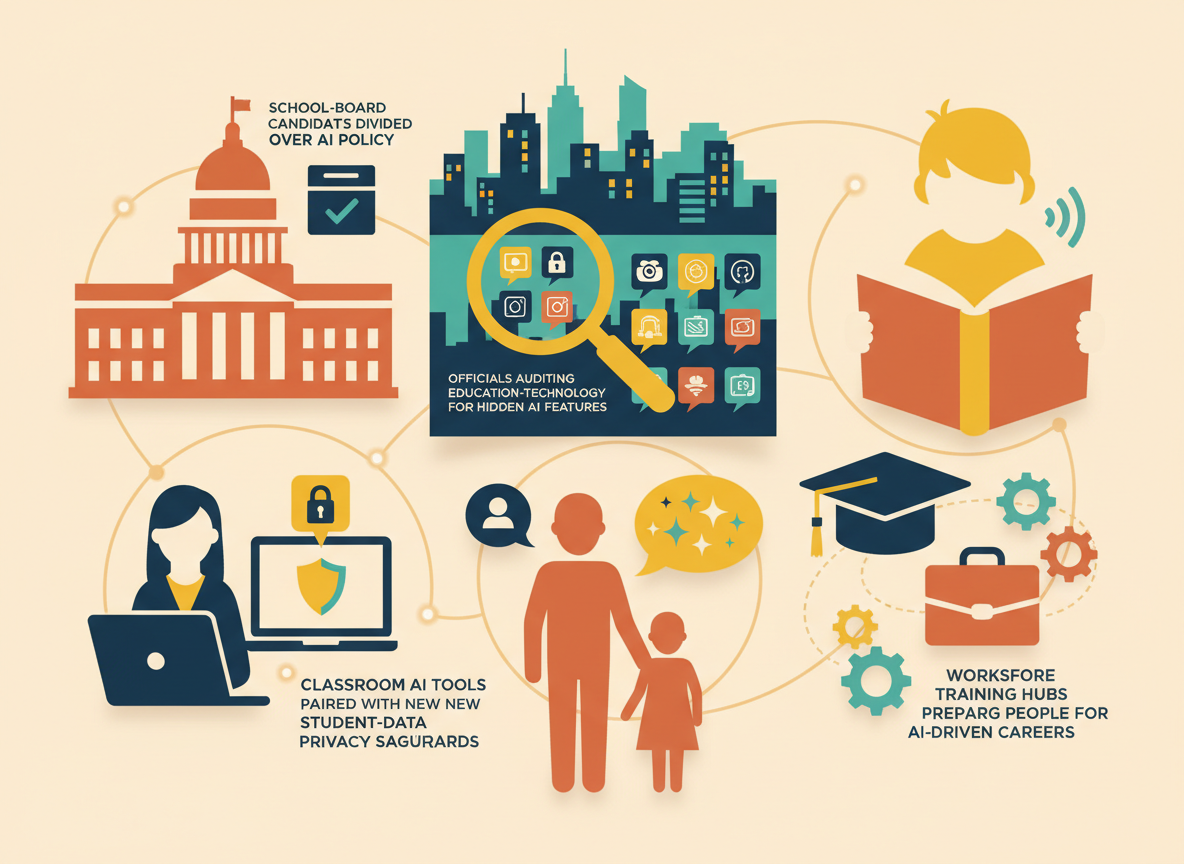
With more than 135 candidates running for seats across Maryland’s 24 school districts, Capital News Service found sharp disagreement over how far AI policy should go: Cecil County’s Brian Hampton backs a K-5 ban he says he’d consider extending through eighth grade, while Wicomico County’s David Plotts argues an outright ban would leave students unprepared for the technology they’ll graduate into. State Sen. Katie Fry Hester, who sponsored Maryland’s AI-integration law, says the goal is “responsible” integration — but with several districts already missing this fall’s policy deadline, that responsibility now falls to whoever wins in November.
Educational Leaders & Principals
New York City’s AI-tool audit turns into a vendor dispute 🚩
Chalkbeat reports that New York City’s Education Department has flagged 38 education-technology products for violating the city’s restrictions on student-facing generative AI — and several vendors say they were flagged in error. Wordly says it doesn’t use generative AI at all; HMH says none of its listed products do either; a translation tool, assessment platforms, and even the department’s own Microsoft-built teaching-assistant chatbot are all caught up in the review. For building leaders, the lesson isn’t the ban itself — it’s that “approved last semester” is no longer a safe assumption for any tool already in the building.
Teachers
A district AI-privacy clause lands on teachers’ desks
New York’s Hoosic Valley Central School District gave first reading this month to a policy update that adds what the district calls “a narrow artificial intelligence provision,” meant to keep students’ personally identifiable information out of AI tools entirely — formalizing, in writing, guidance many teachers elsewhere have only ever heard informally.
MagicSchool AI rolls out for grades 3-6 in a California district
Del Mar Union Elementary, outside San Diego, gave teachers access to MagicSchool AI this month with safety controls built in; staff now manage “student rooms” for grades 3 through 6 under what Assistant Superintendent Abby Domingo’s office calls the district’s push toward “meaningful use of technology” — a small, concrete example of classroom AI expanding even as policy fights play out a state over.
Students
NYC’s ban list catches a reading tutor students already use 🚩
Among the 38 products on New York City’s list is Amira, an AI reading tutor that officials say cannot function without AI — meaning some students who relied on it for practice this fall could lose access while the Education Department finishes its case-by-case review. Education-technology critic Leonie Haimson says the episode shows why the scrutiny matters: “You cannot trust the companies that they’re not using student-facing AI.”
Parents
A European survey finds parents underestimate how much their kids already use AI 🚩
A YouGov survey of French families, commissioned by the NGO Interface, found that among 11-to-12-year-olds, 56% use generative AI regularly — but their own parents estimated only 44% did. The gap narrows with age but never fully closes, and 42% of parents said they feel completely unsupported in helping their kids use AI responsibly. Asked who should bear that responsibility, 51% of parents pointed to teachers and schools first, ahead of the AI platforms themselves.
Employability & Career Readiness
New York opens a $10 million AI jobs hub in Queens
Governor Kathy Hochul this week opened the AI Jobs Institute, a Queens-based hub run by the workforce nonprofit Pursuit, aiming to train up to 40,000 New Yorkers for AI-era careers by 2032. Former U.S. Secretary of Education Miguel Cardona joined the launch — a reminder that even though the Institute’s first programs train adults rather than K-12 students, it’s the job market today’s students are reading about in their own morning announcements.
1 Emerging Trend to Watch This Week — Everyone’s checking everyone’s homework. This week’s stories share a pattern: nobody is simply taking a claim about AI at face value anymore. New York City isn’t trusting vendors’ word that their tools are AI-free. Hoosic Valley is spelling out, in policy language, exactly what teachers can and can’t feed into a chatbot. A University of Florida researcher is the first to say his own data isn’t strong enough yet to call Project Read AI proven. French parents don’t trust their own estimate of what their kids are doing online. Maryland’s school-board candidates can’t even agree on what “responsible” AI use looks like. The industry spent two years asking whether schools would adopt AI. This week’s question was narrower and harder: who’s checking the checkers?
Sources
- Maryland Matters — School Board Candidates View AI With Trepidation
- Chalkbeat — NYC Barred 38 AI Tools in Schools. Some Companies Say Their Products Shouldn’t Be on the List
- Cap Times — A Madison Native Built an AI Tutor. Now It’s Being Put to the Test
- CitizenPortal — Hoosic Valley Board Begins Policy Updates, Discusses AI Privacy Clause
- CitizenPortal — Del Mar Union Elementary Rolls Out MagicSchool AI for Educators
- Euronews — French Kids Use AI Far More Than Their Parents Think, Survey Finds
- Governor Hochul — Announces Launch of AI Jobs Institute to Prepare New Yorkers for Jobs of the Future
Edited by Dr. H. M. Saleem, — Founder, Keynote 180
Discover more from Keynote 180
Subscribe to get the latest posts sent to your email.

