
KEYNOTE 180
Teach · Lead · Learn · Grow — with AI EdTech
AI EdTech Weekly Brief
Issue No. 5 · September 28, 2026 — prepared by Keynote 180 for educators & education leaders.
Recap: Last week’s top story was Atlanta Public Schools drafting AI guardrails ahead of a November board vote. This week, the same tension — policy racing to catch up with practice — played out coast to coast. San Francisco Unified pushed its own AI technology vote out to March 2027, even as new reporting piled fresh complaints onto its year-old Amira reading-tutor contract. Then, on Friday, NPR put a name to what researchers say they’re seeing everywhere: a “Wild West” of districts adopting AI chatbots, and even humanoid robots, with almost no rigorous evidence that any of it works. Different cities, same throughline: adoption is outrunning proof.
This Week’s Trending Tool: Amira — the AI reading tutor San Francisco Unified licenses through a master agreement with Houghton Mifflin Harcourt — is this week’s most-covered, and most-contested, EdTech product. SFUSD pays nearly $400,000 a year for roughly 23,000 K-5 subscriptions, yet third-grade reading proficiency has barely moved (49% this year versus a 52% baseline in 2022), 18 New Mexico districts have already dropped the tool, and the district quietly removed language about how long it keeps children’s voice recordings.
Top Use Cases
District Administrators
Amira’s shifting privacy claims draw district scrutiny 🚩
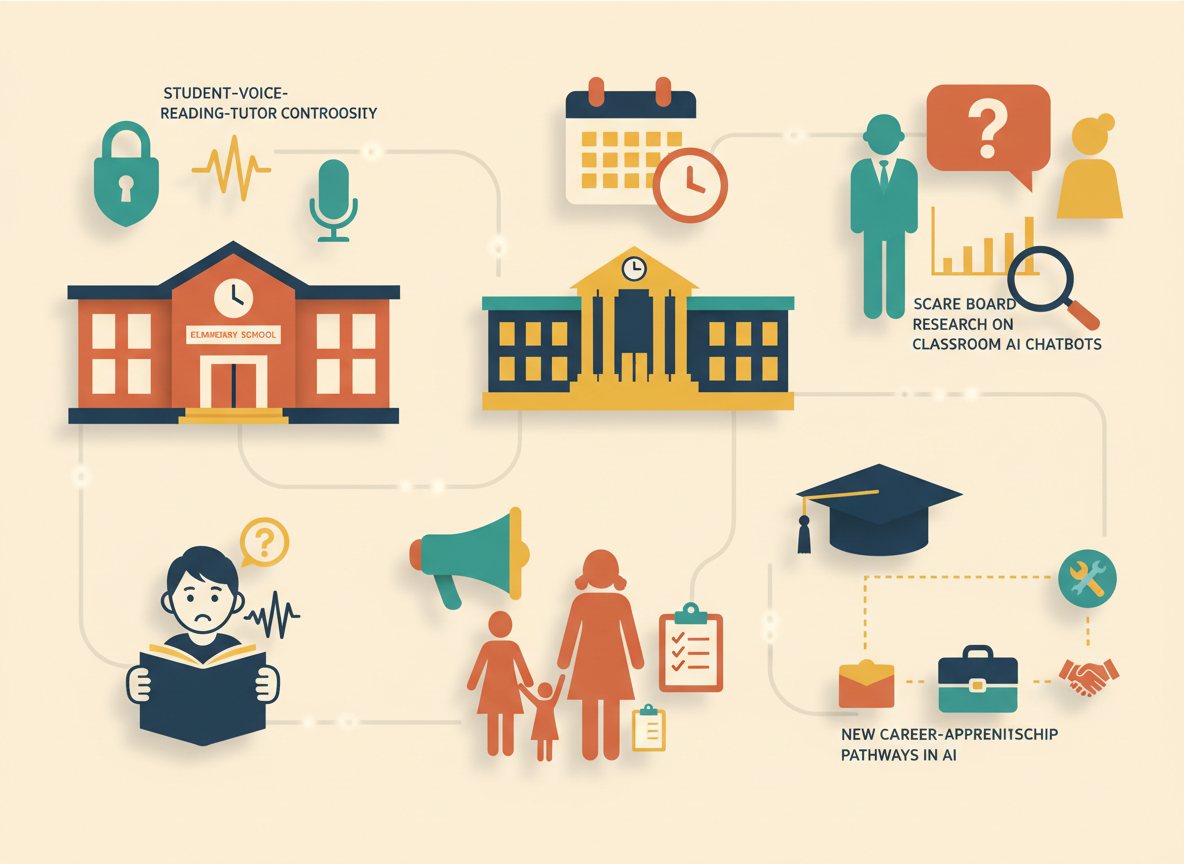
San Francisco Unified’s contract for Amira never explicitly mentions that the tool records children’s voices, and the company’s own privacy claims have moved twice this year: a July 2026 policy said recordings could be used to improve Amira’s underlying AI models, before an August 2026 revision limited that language to “strictly instructional purposes.” In September, SFUSD deleted retention-period language about the recordings from its own website. Eighteen New Mexico districts have already dropped Amira, and SFUSD has now pushed a full technology-policy vote to March 9, 2027, after a board reading in February — leaving administrators elsewhere watching to see whether a licensing model built around recording children’s voices can survive the scrutiny.
Educational Leaders & Principals
“It feels very Wild West”: researchers say adoption is outpacing evidence 🚩
A Stanford review of more than 800 academic papers on AI in K-12 classrooms found little rigorous evidence either way, Robin Lake of the Center on Reinventing Public Education told NPR on September 28: “It feels very Wild West in terms of randomness… there are so many questions… we need state and federal leadership.” Brookings’ Rebecca Winthrop raised similar concerns. The uncertainty is showing up in real decisions: Dayton Public Schools in Ohio is paying $78,650 this year for SchoolAI’s “Jordan” chatbot at its Alternative School at Jackson Center, guided by outside consultant Mike Kentz, while Salamanca City Central School District in western New York shelved a planned $58,000 humanoid robot, “Sally” by Realbotix, after community pushback in July. Leaders are being asked to commit real budget to tools with almost no independent track record.
Teachers
Wichita’s graduated AI rollout leaves teachers defining “success” on the fly
Wichita Public Schools took a staged approach this fall — elementary students learn about AI conceptually, while middle and high schoolers get limited, supervised chatbot access — but the district’s own AI specialist, Katelyn Schoenhofer, told NPR the goalposts are still moving: “We wrestle with what does success really mean?” It’s a question echoed in Dayton, where teachers using the Jordan chatbot day-to-day are essentially writing the usage norms themselves, one classroom at a time, because no state or vendor playbook yet exists for judging whether the tool is actually helping.
Students
Kids say Amira “can’t understand them” 🚩
The San Francisco Standard’s investigation found students, especially those with accents or speech differences, say they have to raise their voices just to get Amira’s voice recognition to register what they’re reading. The usage data backs up the disconnect: kindergarteners in SFUSD averaged only 12 minutes a month on Amira, against a district requirement of 120 minutes — a gap that looks less like non-compliance and more like kids quietly opting out of a tool that isn’t built to understand them.
Parents
A parent-teacher coalition presses SFUSD after its AI vote slips to 2027 🚩
Tech In Check, a coalition led by SFUSD parents who are also district employees — including Sarah Conde-Sulzbach and Kiersten Reta Snavely — has gathered more than 680 petition signatures demanding the district discontinue Amira and return to shared computer carts in grades three through eight instead of individual devices. With the board’s technology-policy reading now set for February 9, 2027 and a vote not until March 9, 2027, the coalition is pointing to the delay itself as proof that the district’s process is moving too slowly to match parents’ concerns.
Employability & Career Readiness
A new coalition puts real money behind school-to-career AI pathways 🚩
Earlier this month, the American Federation of Teachers, CareerWise, and Jobs for the Future launched the Compact for America’s Youth in Washington, D.C., with U.S. Secretary of Education Linda McMahon and CareerWise CEO Brent Parton on hand. The funding is concrete: $150,000 in AFT Career Pathways Partnership Grants, a $400,000 one-year AI initiative from Jobs for the Future and LinkedIn, $500,000 from General Motors for advanced-manufacturing programs in Detroit, and additional apprenticeship funding from the Siemens Foundation, the Walton Family Foundation, and the Annie E. Casey Foundation. It’s a rare example this fall of AI-era career readiness getting dollars attached, not just guidance documents.
1 Emerging Trend to Watch This Week — Evidence is becoming the new battleground. Last week’s throughline was the abandonment of AI-cheating detection. This week’s is broader: from Amira’s shaky efficacy numbers to Stanford’s 800-paper review turning up almost nothing conclusive, districts are starting to ask not just “should we use this?” but “has anyone actually proven it works?” San Francisco choosing to wait until March 2027 rather than decide without better information may be the first sign that more districts are willing to slow down and demand evidence before writing the next generation of AI policy.
Sources
- San Francisco Standard — Why kids, parents, and teachers are so frustrated by SFUSD’s AI reading tutor
- NPR (via WAMC) — Welcome to the ‘Wild West’ of AI in schools: Research is scarce, but experiments abound
- Hoodline — SFUSD delays AI policy vote as NYC, LA restrict tools
- Education Week — How can schools connect students to careers? A new compact has a plan — and money
- Hoodline — Atlanta schools move toward AI rules for students; parents seek clarity
Edited by Dr. H. M. Saleem, — Founder, Keynote 180
Discover more from Keynote 180
Subscribe to get the latest posts sent to your email.

