
KEYNOTE 180
Teach · Lead · Learn · Grow — with AI EdTech
AI EdTech Weekly Brief
Issue No. 6 · October 5, 2026 — prepared by Keynote 180 for educators & education leaders.
Recap: Last week’s top story was San Francisco Unified pushing its AI technology vote out to March 2027 while researchers told NPR that classroom AI adoption is running well ahead of any real evidence it works — a “Wild West,” as one put it. This week, that same tension — enthusiasm outrunning oversight — resurfaced in Texas, where reporting revealed that Education Commissioner Mike Morath’s own agency helped broker public-school access to an unproven AI platform just months after the State Board of Education had rejected that same technology’s charter-school bid over the exact same concerns.
This Week’s Trending Tool: TimeBack — the AI-delivered instructional platform built by Alpha School and co-founder MacKenzie Price — is this week’s most contested EdTech product. The Texas Tribune and ProPublica (Oct. 1) and Houston Public Media (Oct. 2) reported that the Texas Education Agency organized campus visits and helped place TimeBack in pilots at Houston ISD, Fort Davis ISD (about 800 students), and Aldine ISD (roughly 300 students across four middle schools) — months after the State Board of Education voted 10-3 in June 2025 to reject an Alpha charter application over unverified “learn twice as fast” claims, and after a Texas Prep School campus using the same model posted just a 21% state-exam pass rate and an F rating.
Top Use Cases
District Administrators
Texas TEA facilitates Alpha School’s AI platform into public districts 🚩
Investigations by the Texas Tribune, ProPublica, and Houston Public Media found that Commissioner Mike Morath’s Texas Education Agency actively connected Alpha School’s TimeBack platform — AI-delivered core instruction paired with human “guides” — to Houston ISD, Fort Davis ISD, and Aldine ISD, with staff drafting promotional materials and Morath personally offering to introduce an Alpha leader to Houston ISD’s superintendent. The TEA says “there is no formal partnership,” but the outreach followed the State Board of Education’s 10-3 rejection of an Alpha charter in 2025 and a 21% exam pass rate at a Texas Prep School campus using the same model. Five other districts — Ector County, Fort Bend, Irving, Pecos, and Pflugerville — were approached and declined. For administrators elsewhere, it’s a case study in how far a state agency’s enthusiasm can run ahead of its own board’s skepticism.
Educational Leaders & Principals
Google pushes Gemini deeper into the classroom workflow
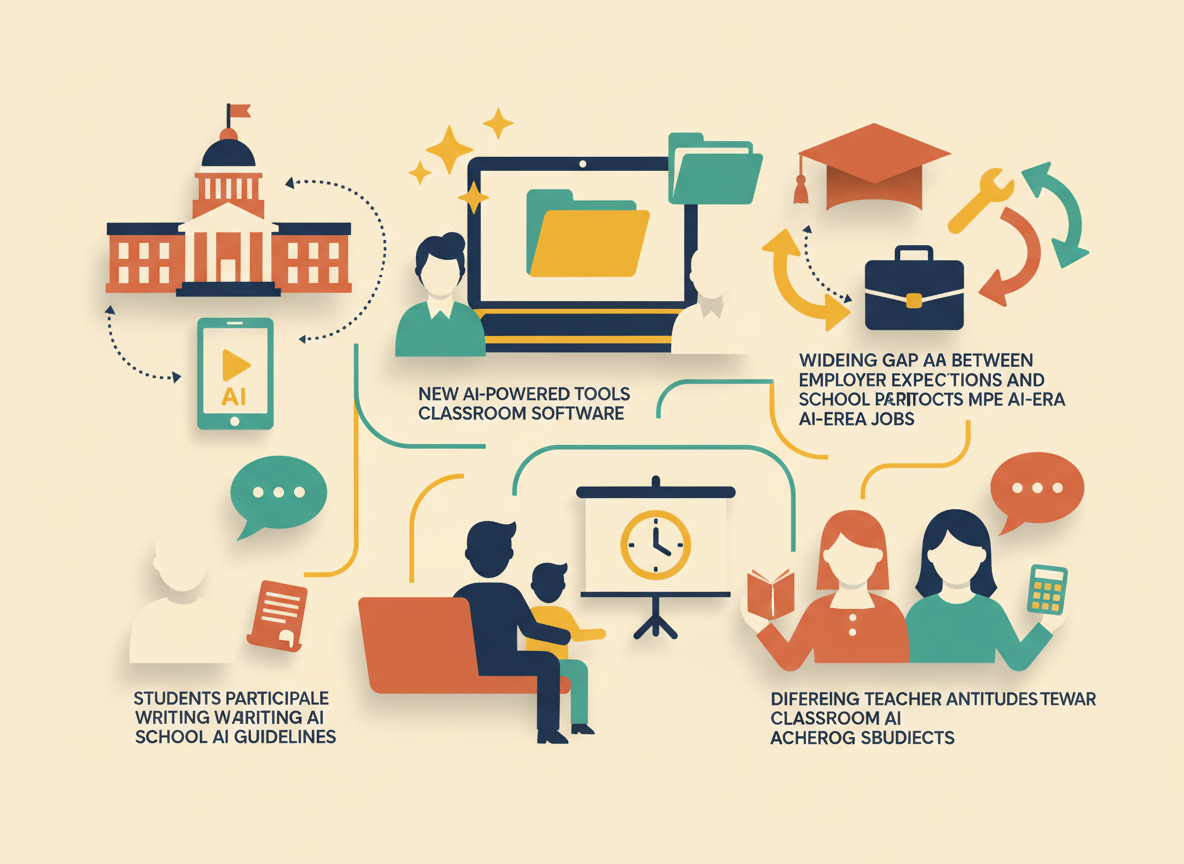
On October 1, Google rolled out a Google Classroom-connected app inside Gemini, letting teachers pull live class context — rosters, assignments, performance data — directly into AI-generated insights, alongside new AI-powered scaffolding built on learning-science principles. “The Classroom app will ground Gemini’s responses in the most relevant information for that teacher,” said Brit Mennuti, Google’s Classroom product lead. The rollout lands as whole states commit at scale: Google’s partnership with the Utah State Board of Education is bringing Gemini for Education to roughly 680,000 K-12 students and 28,000 teachers statewide this school year. For principals, the question is shifting from whether to adopt a classroom AI assistant to how quickly staff can be trained on one that is already arriving by default.
Teachers
A new survey finds English and math teachers split sharply on AI
A survey of 222 Washington state high school math and English teachers, highlighted this week by three Central Washington University faculty — Josh Aubol, Steve Stein, and Peter Klosterman — writing in the Washington State Standard (Oct. 4), found 57% of English teachers say AI has worsened their teaching attitude, versus 37.6% of math teachers, and 83.7% of English teachers report academic-integrity concerns, versus 54.9% of math teachers. The authors argue the split calls for discipline-specific training rather than one-size-fits-all policy: English teachers need help designing AI-resistant assignments, while math teachers are already finding AI useful for cutting administrative work.
Students
Michigan students are already using AI faster than their schools can guide them 🚩
In an October 5 op-ed, retired civics teacher Keith Kindred cites survey data showing 58.4% of Michigan students used AI for schoolwork in the past 30 days, while nearly a quarter received no guidance at all on acceptable use. Some districts are moving to close that gap: Ann Arbor Public Schools had students help write the district’s own AI expectations and an “AI Bill of Rights,” and St. Joseph Public Schools is partway through a three-year, phased AI-integration plan. Kindred points to research showing unrestricted ChatGPT use can leave students scoring worse on surprise tests (57.5% vs. 68.5%) as a reminder that “assistance” and “substitution” aren’t the same thing.
Parents
A Colorado nonprofit is teaching parents the basics, not banning the tool
On October 20, the Colorado nonprofit Parent Engagement Network will host “Navigating AI,” an evening workshop at Dawson School’s Innovation Center in Lafayette, aimed at moving families “from confusion and concern to clarity, confidence, and agency.” It’s led by two Boulder Valley School District parents — CU Boulder aerospace engineering professor Bobby Hodgkinson and ALLCITY Network COO Michael Whitaker — with sliding-scale admission and supervised childcare provided. For parents still sorting out what to make of AI homework help and chatbots, it’s a sign that parent-led AI literacy efforts are becoming their own small movement alongside district policy.
Employability & Career Readiness
Employers and educators disagree — sharply — about whether students are AI-ready 🚩
A Battelle study reported by Spectrum News 1 (Sept. 25) found more than half of employers and HR decision-makers believe students are not prepared for AI-era jobs, while more than 80% of educators believe their own students are. “We want to move toward developing a solution,” said Battelle senior vice president Wes Hall, arguing that readiness now requires pairing technical AI skills with distinctly human ones machines can’t replace. The gap lands the same week the AFT-CareerWise-Jobs for the Future “Compact for America’s Youth” — covered in Issue No. 5 — is still distributing its grant dollars, a reminder that funding school-to-career AI pathways and agreeing on what “ready” means are two very different problems.
1 Emerging Trend to Watch This Week — Readiness gaps are showing up everywhere you look. From a state agency outrunning its own board’s caution in Texas, to Michigan students outpacing their schools’ guidance, to employers and educators disagreeing by double digits about whether students are prepared, this week’s throughline isn’t adoption or evidence anymore — it’s that the people closest to AI in schools disagree, often sharply, about what “ready” even means, and almost nobody has caught up to settle it.
Sources
- The Texas Tribune — How Morath’s agency linked Texas schools to Alpha’s AI tool
- ProPublica — How Mike Morath’s Agency Linked Texas Schools to Alpha’s AI Tool
- Houston Public Media — How Mike Morath’s agency helped get an AI tool in Texas public school classrooms
- EdTech Magazine — Google Launches New AI Tools Purpose-Built for Education
- Google — Google and Utah State Board of Education partner on Gemini tools
- Washington State Standard — Commentary: Artificial intelligence in the classroom
- Michigan Public — Opinion: AI is forcing Michigan schools to rethink learning
- Parent Engagement Network — Navigating AI: An Evening Workshop
- Spectrum News 1 — New Battelle study finds gap in AI workforce readiness expectations
Edited by Dr. H. M. Saleem, — Founder, Keynote 180
Discover more from Keynote 180
Subscribe to get the latest posts sent to your email.

