
KEYNOTE 180
Teach · Lead · Learn · Grow — with AI EdTech
AI EdTech Weekly Brief
Issue No. 4 · September 21, 2026 — prepared by Keynote 180 for educators & education leaders.
Recap: Last week’s top story was infrastructure: Microsoft, the AFT, and New York’s UFT unveiled the first enforceable national AI safety and privacy standard for schools on September 9, landing the same week Florida’s State Board of Education chose opt-in parental consent over an outright ban. We checked for follow-up since then, and the pattern held: Atlanta Public Schools is now drafting its own AI guardrails ahead of a November board vote, becoming the latest major district to turn a summer of ad hoc restrictions into a written policy. Contracts, consent, and now city-by-city drafts — 2026 keeps converting AI oversight into paperwork instead of just talking points, and this week’s stories show that same shift playing out in classrooms, counselors’ offices, and career labs alike.
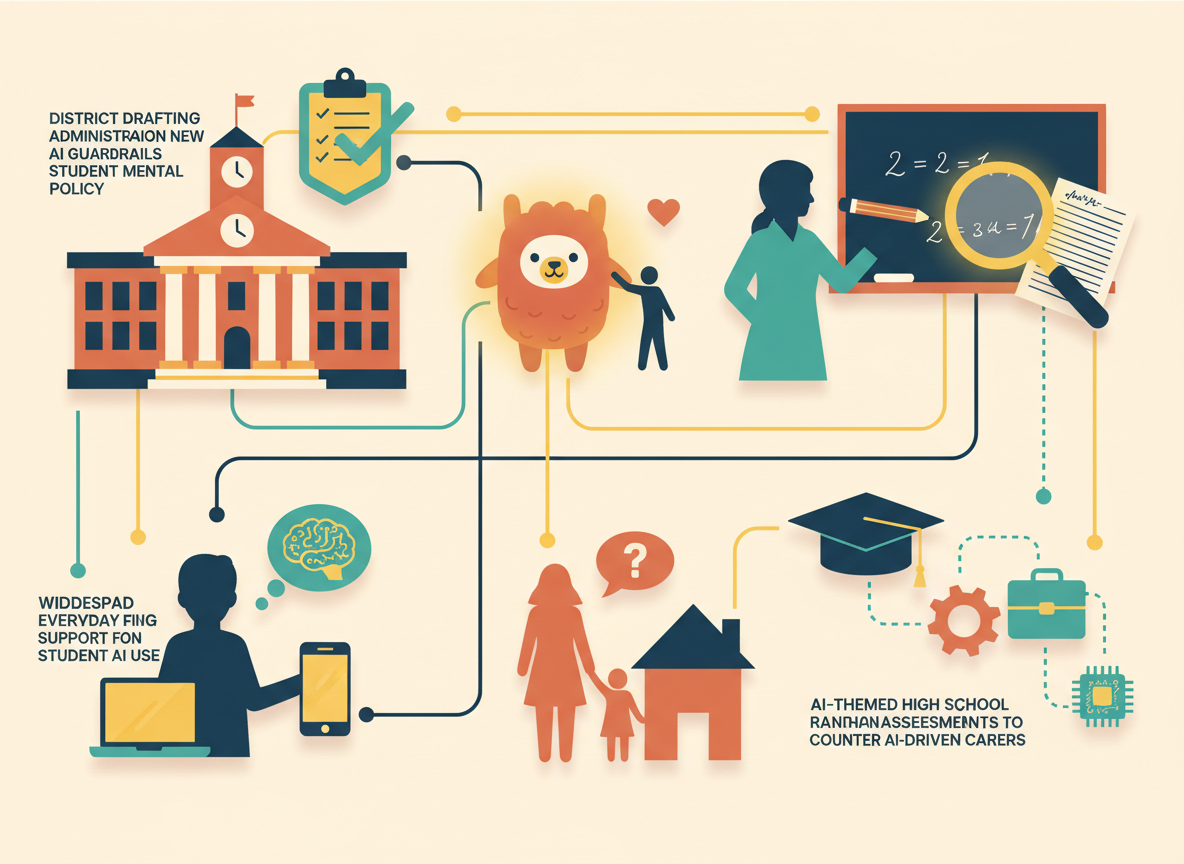
This Week’s Trending Tool: Alongside — the AI wellness platform behind its orange-yellow llama chatbot, Kiwi — is now live in more than 200 schools across 19 states, and it’s the source of the most-quoted line in K-12 media this month: a principal saying, simply, “we actually saved a kid.”
Top Use Cases
District Administrators
Atlanta Public Schools drafts AI guardrails ahead of a November vote 🚩
Atlanta joined the growing list of districts turning informal AI norms into board-approved policy on September 17, when officials confirmed a draft rule headed for a November vote. The proposal would bar students from using chatbots like ChatGPT to generate finished assignments, permit AI only when it’s tied to a specific instructional objective, let teachers use AI for lesson planning, and ban teachers from entering sensitive student information into any AI platform. District officials called AI “a moving target” and acknowledged that many parents don’t yet understand its pitfalls — a tension sharpened by Georgia’s own state mandate requiring AI-literacy instruction even as organized parent groups push for stricter guardrails.
Educational Leaders & Principals
“We actually saved a kid” — a principal’s case for AI-assisted wellness checks 🚩
At Corsicana High School in Texas, where three counselors serve roughly 1,800 students, Principal Aaron Tidwell’s decision to bring in Alongside’s Kiwi chatbot faced its first real test this month: a student disclosed a detailed self-harm plan to Kiwi before leaving campus for the weekend, the platform flagged it immediately, and staff intercepted the student in time to start a crisis intervention. “We actually saved a kid,” Tidwell said. Nationally, nearly 31,000 students logged close to 28,000 hours on Alongside this past year, and more than 1,800 were flagged for immediate intervention — numbers that land against a backdrop where 40% of high schoolers report persistent sadness and 20% have seriously considered suicide, per CDC data. Common Sense Media rates Alongside “low-risk,” a marked contrast to its “unacceptable risk” rating for general consumer chatbots used the same way.
Teachers
“Nearly impossible”: teachers give up on catching AI cheating, go back to paper 🚩
Reading Public Schools in Massachusetts presented its new AI approach to the School Committee on September 10: rather than fixed rules, a “living document” that requires teacher permission before students use AI on any assignment, alongside a Magic School pilot with student guardrails rolling out in grades 7-8. But the more telling news came from the teachers themselves. “The catch on it is nearly impossible,” said chemistry teacher Richard Estes. “As soon as you develop something that lets you check to cheat, something else is made to cancel out that check.” Estes has gone back to in-class, pen-and-paper assessments; social studies teacher Jessica Bailey now leans on process-based work and discussion instead of take-home writing.
States tell teachers to embrace AI, then leave them to police it alone
A Chalkbeat review found that roughly three in four states have now published AI guidance for schools, but most of it focuses on literacy and teacher efficiency while barely touching academic integrity — leaving classroom teachers to invent their own cheating-detection strategies with little state support. More than a third of states explicitly warn against relying on AI-detection tools at all. At least 13 states have passed AI-in-education laws so far, but as one Virginia school board member put it, telling teachers to both adopt AI and independently police misuse is turning into “an exhausting endeavor” with no clean answer in sight.
Students
AI use among teens is nearly universal — understanding isn’t keeping pace 🚩
Two new surveys out this month put hard numbers on what teachers already sense in the room: 70% of teens say they use AI for schoolwork, according to Common Sense Media, and 84% of high schoolers report using generative AI for assignments, per a College Board survey cited alongside coverage of Georgia’s Seckinger High School. Yet an IBM-commissioned study found only about half of K-12 students actually understand how the AI they’re using works — even as 62% of their teachers are already using it themselves. The gap between using AI and understanding it, not access to the tools, is becoming this year’s real literacy problem.
Parents
Atlanta parents want clarity, not just a policy
The same Atlanta Public Schools draft policy generating headlines for administrators this week is landing differently with parents, who say the pace of change is outrunning communication. The district has already fielded pushback over Amira, an AI reading screener that records students’ voices, and is exploring alternatives after parent concerns. One district administrator conceded that many parents “may not understand the pitfalls of AI and chatbots” — an admission that cuts both ways, since it’s also an argument for the district to explain itself better before the November vote, not just write the rule and move on.
Employability & Career Readiness
Inside the nation’s first “AI-themed” public high school 🚩
Seckinger High School in Buford, Georgia — which opened in 2022 as the country’s first AI-themed public high school — is drawing fresh national attention this month for a simple bet: teach AI as a practical, ethical skill instead of banning it. Its six-part framework threads programming, data science, mathematical reasoning, creative problem-solving, ethics, and applied experience through every subject, an approach architect Babak Mostaghimi has built since 2017. Student Gabrielle Watkins says ethics is the framework’s most critical piece. The payoff shows up in results: Seckinger students outperform the state average in math, reading, and science. IBM, which commissioned the K-12 AI-readiness research behind this month’s coverage, is launching a fall fellowship for 100 education leaders to help other districts build something similar.
1 Emerging Trend to Watch This Week — Detection is dead; verification is next. From Reading, Massachusetts to statehouses nationwide, this week’s throughline was the quiet abandonment of AI-cheating detection as a strategy. Teachers aren’t waiting for better detection software — they’re redesigning assessment itself: pen-and-paper tests, in-class discussion, process-based grading. Watch for this to become the next policy battleground, as districts realize that writing rules about acceptable AI use is the easy part; verifying that students actually did the thinking is the part nobody has solved yet.
Sources
- Hoodline — Atlanta schools move toward AI rules for students; parents seek clarity
- EdSource — ‘We actually saved a kid’: schools recruit AI chatbots as counselor shortage persists
- Reading Recap — RPS lays out AI approach as teachers say catching cheaters is “nearly impossible”
- KOTA TV / Chalkbeat — States urge schools to use AI, but leave teachers on their own to stop cheating
- IBM — US schools are banning AI or ignoring misuse; this “AI-themed” high school found a better way
Edited by Dr. H. M. Saleem, — Founder, Keynote 180
Discover more from Keynote 180
Subscribe to get the latest posts sent to your email.
 Keynote 180